Community Storytelling vs. Trend-Chasing

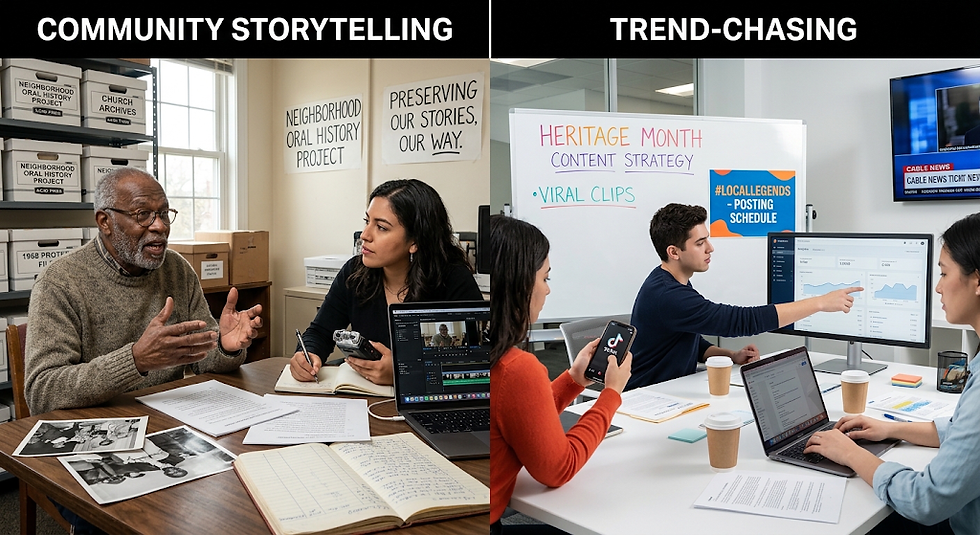
Two organizations can tell what looks, on the surface, like the same kind of story — a piece of local history, a community's voice, a "heritage" campaign — and be doing two completely different things.
One is community storytelling. The other is trend-chasing wearing community storytelling's clothes. The difference isn't visible in the first thirty seconds. It shows up in what happens after.
Trend-chasing starts with the calendar. A heritage month arrives, a cultural moment goes viral, a competitor gets praised for "authentic" content — and suddenly there's a brief for a story that centers a community the organization has no ongoing relationship with. The story gets built fast, it performs well for a news cycle, and then it disappears, because it was never built to be revisited. The community was a subject. The engagement was the point.
Community storytelling starts with a relationship that predates the project. It asks who's already doing this work — the local historian, the family archive, the elder who's been telling this story for forty years with no camera in the room — and it builds around them instead of around a content calendar. It's slower. It often produces less in the first quarter. And it's still standing five years later, because the relationship it was built on didn't end when the deliverable shipped.
A few honest questions separate the two:
Who benefits if this goes well? If the honest answer is "mostly us," it's trend-chasing with better lighting. If the community itself gains something durable — an archive, a platform, ownership of their own narrative, actual resources — it's storytelling done right.
Would this story still make sense in five years? Trend-chasing is timestamped to a moment. Community storytelling is built to be told again, by someone else, and still hold up.
Who has the authority to tell this, and did they say yes? Not "did we get a quote" — did the people whose history this is have real authority over how it's told, including the authority to say a version of it is wrong.
Is the community a co-author or a case study? Case studies get referenced. Co-authors get credited, compensated, and consulted on what happens next.
This is the difference between a Juneteenth post and a decade of relationship with the people who've been doing that history's work all along. Between a heritage campaign and a civic memory project that outlives the person who commissioned it. Between borrowing a moment and building something that a community can point to and say — that one's ours.
Trend-chasing is fast, cheap, and forgettable. Community storytelling is slow, relational, and durable. Only one of them is actually strategy.


Comments